
— Available now · September 2026
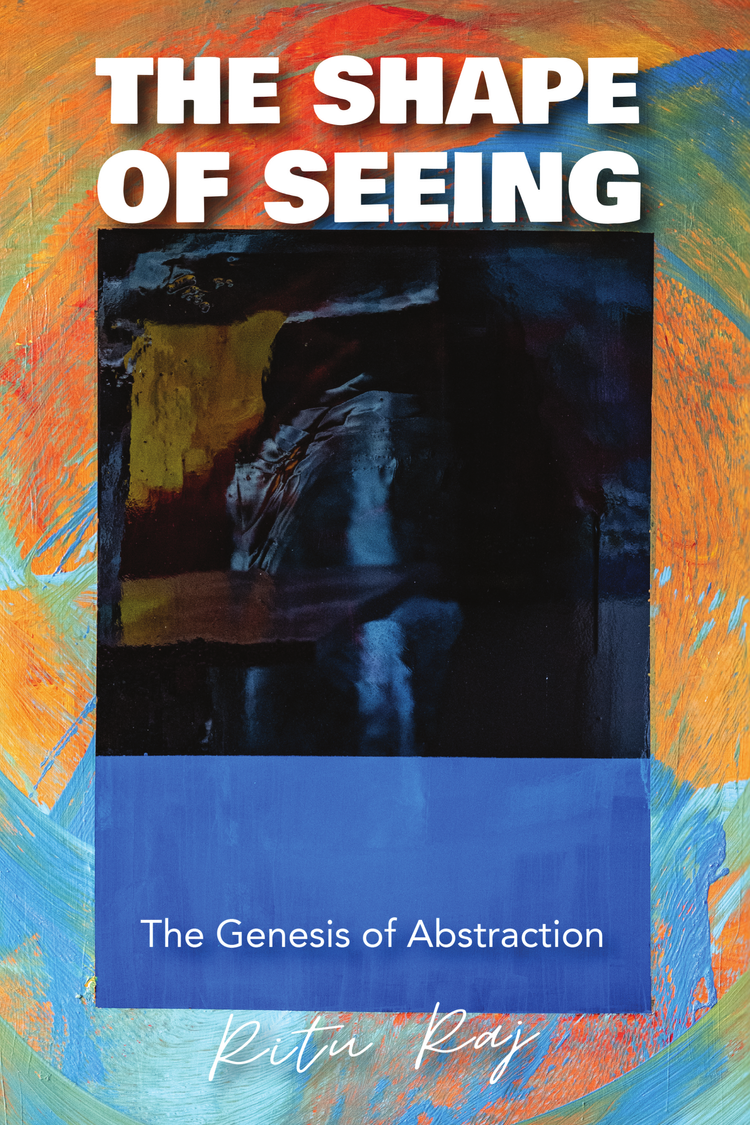
The Shape
of Seeing
The Genesis of Abstraction
Twenty chapters on painting, perception, silence, and the infinite return. From a childhood in New Delhi steeped in India’s modernist painters to a studio in the Arizona desert — the book of a lifetime’s looking, finally given form.
“I don’t paint what I know. I paint to know.”
— About the book
Where emotion becomes geometry.
The Shape of Seeing is not a memoir in the conventional sense. It is an inquiry — into abstraction, consciousness, perception, and the act of making marks on a surface when the world has gone silent.
In 2020, Ritu Raj reached into a kitchen drawer and found a length of ordinary string. He dipped it in pigment. What the arc left behind — shuddering, pooling, refusing control — was not a painting. It was a question. This book is the attempt to answer it across twenty chapters.
“Abstraction is not a style. It is the point where intellect dissolves into awareness — where seeing becomes a form of being.”
From the geometry of silence to the ethics of attention, from the body of seeing to the infinite return — each chapter is a meditation, a gesture, a line pulled across the surface of thought.
“The weight of time, the texture of silence, the movement within stillness.”— Artist statement
— Contents
The arc of inquiry.
Each chapter is a meditation, not an argument. The book does not resolve its questions. It holds them open, the way a great painting refuses to conclude.
- Introduction
The Moment of Return
A length of string. A kitchen drawer. The first arc that refused control.
- Chapter 1
In the House of Art and Language
New Delhi. A critic father. A mother who taught literature. Husain, Souza, Raza at the dinner table.
- Chapter 2
The Geometry of Silence
Mathematics as another way of seeing. Equations as composition. Zero as potential.
- Chapter 3
The Language of Color
Decades in technology. Standing before a Rothko. The long silence as architecture.
- Chapter 4
The String and the Breath
The birth of Organic Movement. Migration. DNA on Fire. The accident that was method.
- Chapter 5
The Architecture of Stillness
Building a visual grammar. Silence as structure. Erasure as punctuation.
- Chapter 6
Why Abstraction
Representation comforts; abstraction confronts. The art of being.
- Chapter 7
The Return to Wonder
The studio as laboratory. Mistakes as revelation. Inquiry without destination.
- Chapter 8
Color as Consciousness
Red expands. Blue recedes. White holds silence. Color is what I become.
- Chapter 9
The Digital Studio
Photography as abstraction. Writing as parallel practice. Silence offered into noise.
- Chapter 10
The Shape of Time
Time is circular in the studio. Layers as memory. The canvas becomes time.
- Chapter 11
The Line and the Breath
The line came before everything. Dip. Pull. Release. Thought before translation.
- Chapter 12
In the Company of Shadows
Darkness as depth. The studio at dusk. Light lives within shadow.
- Chapter 13
Geometry of Emotion
Emotion has structure — invisible, but exact. Balance as compassion.
- Chapter 14
Inheritance of Vision
We inherit how to see, not what to see. The studio still holds their books.
- Chapter 15
The Body of Seeing
Painting is thought through the body. The hand remembers what the mind forgets.
- Chapter 16
The Ethics of Attention
Attention is love without possession. To see fully is a moral act.
- Chapter 17
Matter and Spirit
Art, finally, is matter remembering it was once light.
- Chapter 18
Of Silence and Sound
Every painting begins in silence — but silence hums.
- Chapter 19
The Horizon Within
The horizon is not the edge of sight. It is the origin of vision.
- Chapter 20
The Infinite Return
To begin again is the most sacred gesture of all. Art never concludes.
- Epilogue
Art never ends. It only changes form.
The conversation continues. The surface awaits. The next horizon is already forming.
— The artist
Structure and feeling.
— The book is here
Read it. Then come see the paintings.
The Shape of Seeing is available now in hardcover, paperback and Kindle. Join the collectors list for new work, studio notes and private sales, before anything goes public.